

 ·
11 minute read
·
11 minute read
Setting an OKR can feel like a major step. You define an objective. You agree on key results. You communicate the priorities. Everyone knows what the organization wants to achieve. And then the real work begins. Because an OKR does not achieve itself. The difficult question is what happens after the OKR has been defined. How does it influence what people work on tomorrow? How do you decide which projects matter? How do meetings contribute to the objective? How do you track whether the work is actually moving the Key Result? And what happens when the data tells you that your original plan is not working?
This is where OKR execution begins.
A useful way to think about the process is:
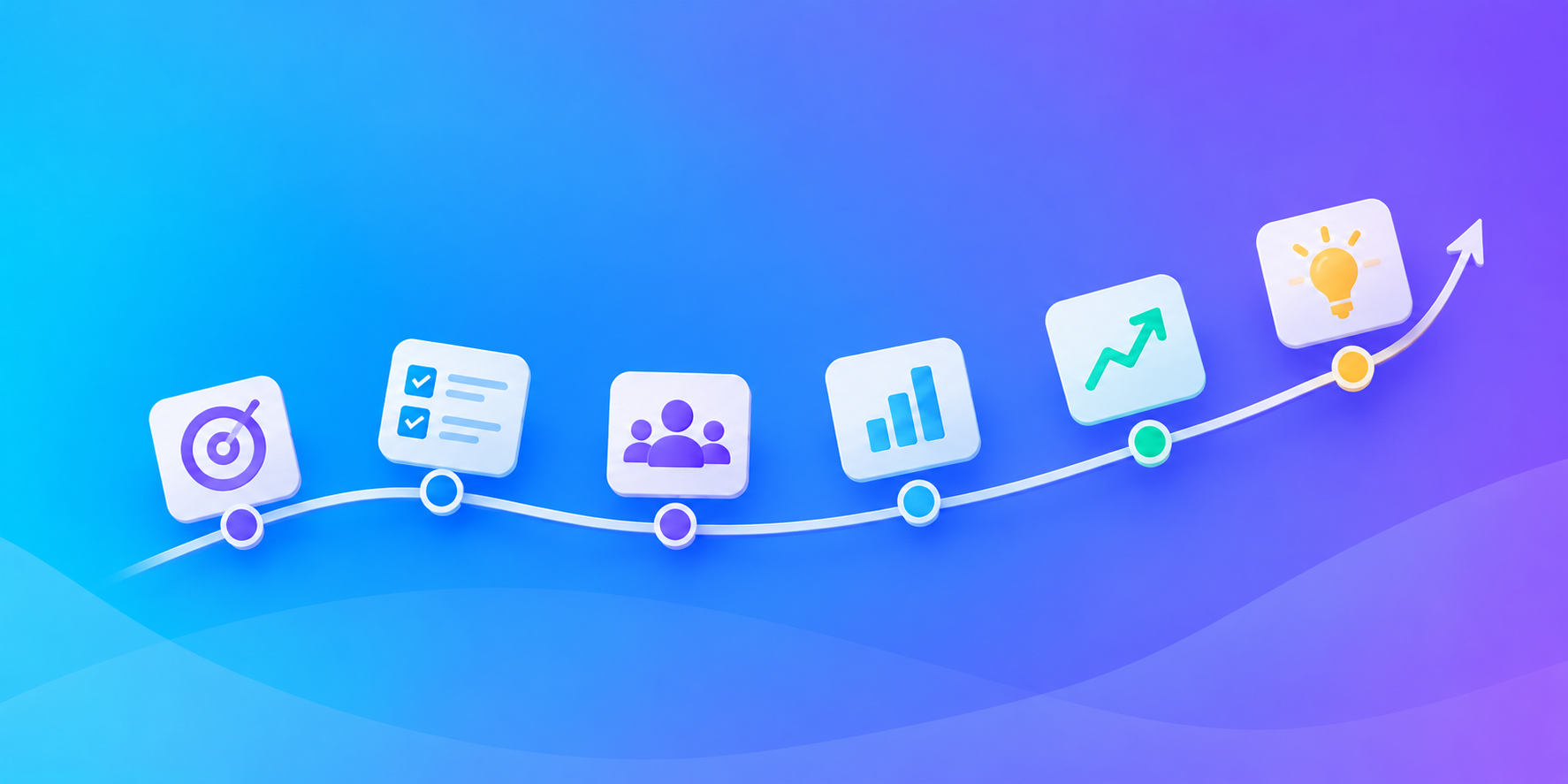
OKR → Work → Meetings → Data → Progress → Learning
The OKR creates direction. Execution turns that direction into coordinated work. Data shows what is happening. Learning helps the team decide what to do next.
Setting an OKR is not the same as executing it
An OKR can be clearly written and still have little influence on everyday work.
Imagine a company sets the following objective:
Improve customer activation.
With a Key Result:
Increase activation from 42% to 60%.
The objective is clear. The Key Result is measurable. But what happens next?
Someone needs to:
- analyze activation data,
- identify where users are dropping off,
- interview customers,
- improve onboarding,
- test changes,
- coordinate product and marketing,
- review the results,
- decide what to do next.
Those activities are the execution layer. Without that layer, the OKR remains a statement of intention. The connection needs to look more like:
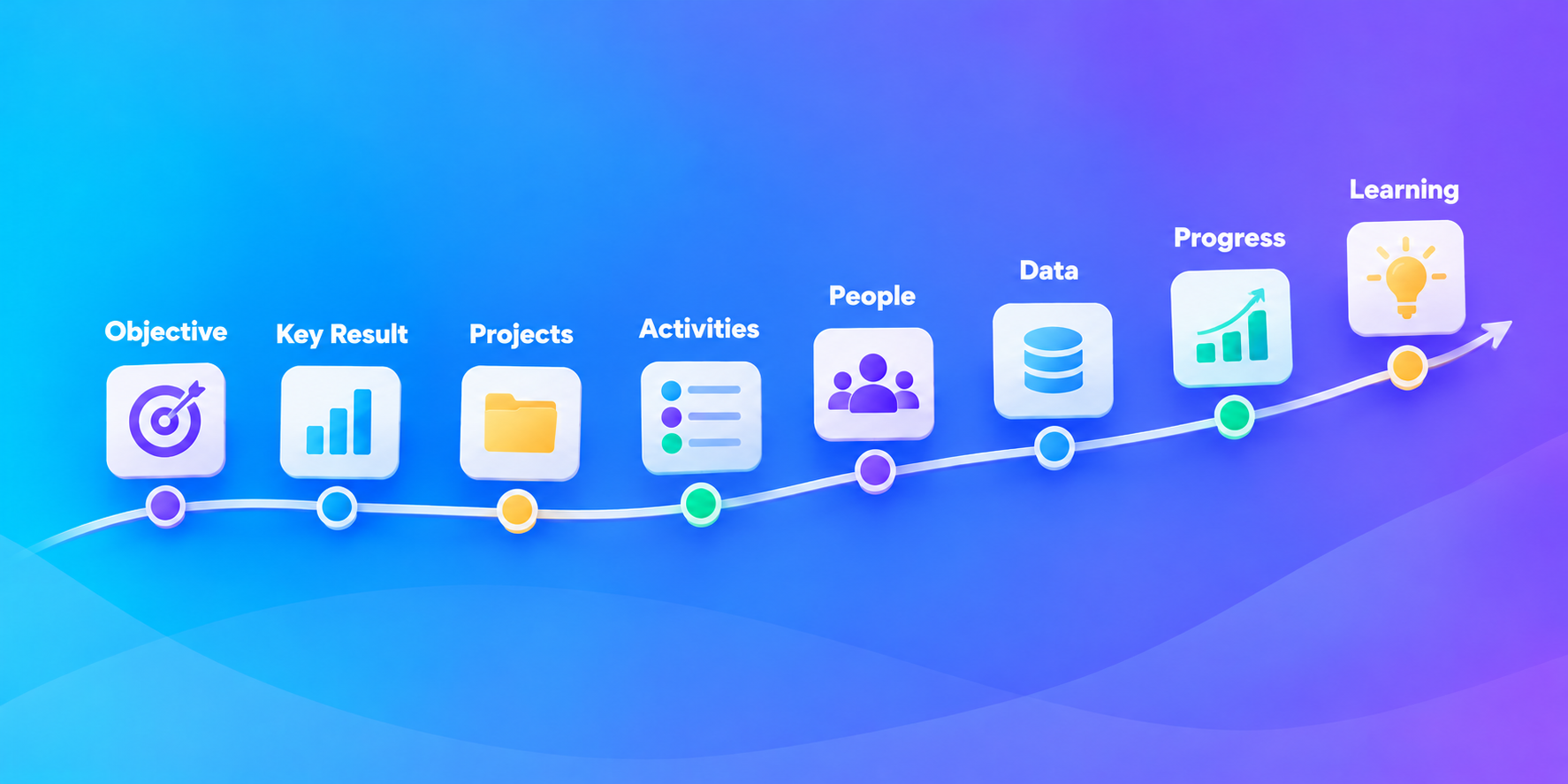
That is the part of OKR management that often receives less attention.
What is OKR execution?
OKR execution is the process of translating an objective and its Key Results into coordinated work, ownership, measurable progress and ongoing decisions.
It answers a different set of questions than OKR setting.
OKR setting asks:
What do we want to achieve?
OKR execution asks:
What needs to happen to achieve it?
And then:
Who needs to do it?
What should happen this week?
Which work should be prioritized?
How will we measure progress?
What does the data tell us?
What should we change?
This is why OKR execution is closely connected to broader strategy execution. The OKR defines the destination. Execution creates the path.
The gap between OKRs and everyday work
One of the biggest challenges with OKRs is the distance between strategic language and daily activity. Consider:
Objective
Increase customer retention.
Key Result
Increase quarterly retention from 82% to 90%.
Now compare that with what employees actually see during the day:
Analyze customer feedback.
Update onboarding materials.
Schedule customer interviews.
Review churn data.
Prepare product recommendations.
Contact at-risk customers.
Create a retention campaign.
These activities may all contribute to the Key Result. But unless the relationship is visible, they can look like unrelated tasks. The team may know: what to do without knowing: why it matters. The purpose of execution is to close that gap.
The OKR Execution Framework
A practical framework can be built around seven connected steps:
1. Define the outcome
2. Translate the outcome into work
3. Assign ownership
4. Connect work to goals
5. Turn meetings into execution
6. Connect progress to data
7. Review, learn and adjust
Let's look at each one.
1. Define the outcome
The first step is understanding what the OKR is actually trying to change. An objective gives direction. Key Results define measurable indicators of success. But teams also need to understand the intended outcome.
For example:
Objective
Improve customer activation.
Key Result
Increase activation rate from 42% to 60%.
The important question is:
What needs to change in the business or customer experience for this Key Result to move?
Perhaps users need to reach their first meaningful product outcome faster. Perhaps onboarding is creating friction. Perhaps customers do not understand the product's value. The Key Result tells you what needs to change quantitatively. The execution process needs to explore what might cause that change.
2. Translate the OKR into actual work
This is where an OKR moves from planning into execution.
Start asking:
What needs to happen to influence this Key Result?
For example:
Objective
Improve customer activation
↓
Key Result
Increase activation from 42% to 60%
↓
Potential work
- Analyze activation funnel
- Interview new users
- Identify onboarding friction
- Redesign onboarding
- Run activation experiments
- Improve product guidance
- Monitor activation changes
Now the OKR has a relationship with actual work.
The structure becomes:
OKR → Projects → Activities
This is much more actionable than simply communicating the objective to the team.
3. Break strategic goals into manageable pieces
Large objectives can be difficult to execute as one unit. Breaking them into subgoals can make the work more manageable.
For example:
Objective
Improve customer activation
↓
Subgoals
Understand activation barriers
Improve onboarding
Increase first-value completion
Measure activation experiments
↓
Activities
Customer interviews
Funnel analysis
Onboarding redesign
Experiment setup
Results review
This creates a hierarchy:
Objective → Subgoal → Work
Beenia supports parent goals and subgoals, allowing larger objectives to be structured into smaller parts while keeping them connected to the broader goal.
4. Connect the work to the goal
This is one of the most important steps.
A task should not simply exist in a task management system.
For important strategic work, it should have context.
Instead of:
Task: Analyze onboarding
you want to know:
Task: Analyze onboarding
→ Goal: Improve customer activation
→ Key metric: Activation rate
Now the person doing the work can understand its purpose. This is particularly useful when teams have many competing priorities. When a new request arrives, ask:
Which goal does this support?
If the answer is unclear, the team has an opportunity to reconsider its priority.
Beenia's product model specifically supports connecting activities directly to goals, including rule-based matching that can automatically associate activities with appropriate goals based on defined conditions.
5. Give every important piece of work an owner
An OKR is shared. Execution still requires responsibility.
For example:
Key Result | Work | Owner
- Increase activation to 60%, Analyze activation funnel, Product
- Increase activation to 60%, Interview new users, Customer Success
- Increase activation to 60%, Improve onboarding, Marketing
- Increase activation to 60%, Create onboarding content, Marketing
Now the relationship is visible:
Key Result → Work → Owner
This helps avoid a common problem:
“We all own the OKR.”
When everyone owns something collectively, individual responsibilities can sometimes become less clear. Shared outcomes still need clearly assigned work.
6. Turn meetings into part of execution
OKRs are often discussed in meetings. Teams review progress. Leadership asks questions. Priorities change. Decisions are made. New actions are created. But what happens after the meeting? This is where many execution processes become fragmented.
A useful model is:
Meeting → Decision → Activity → Goal → Result
For example:
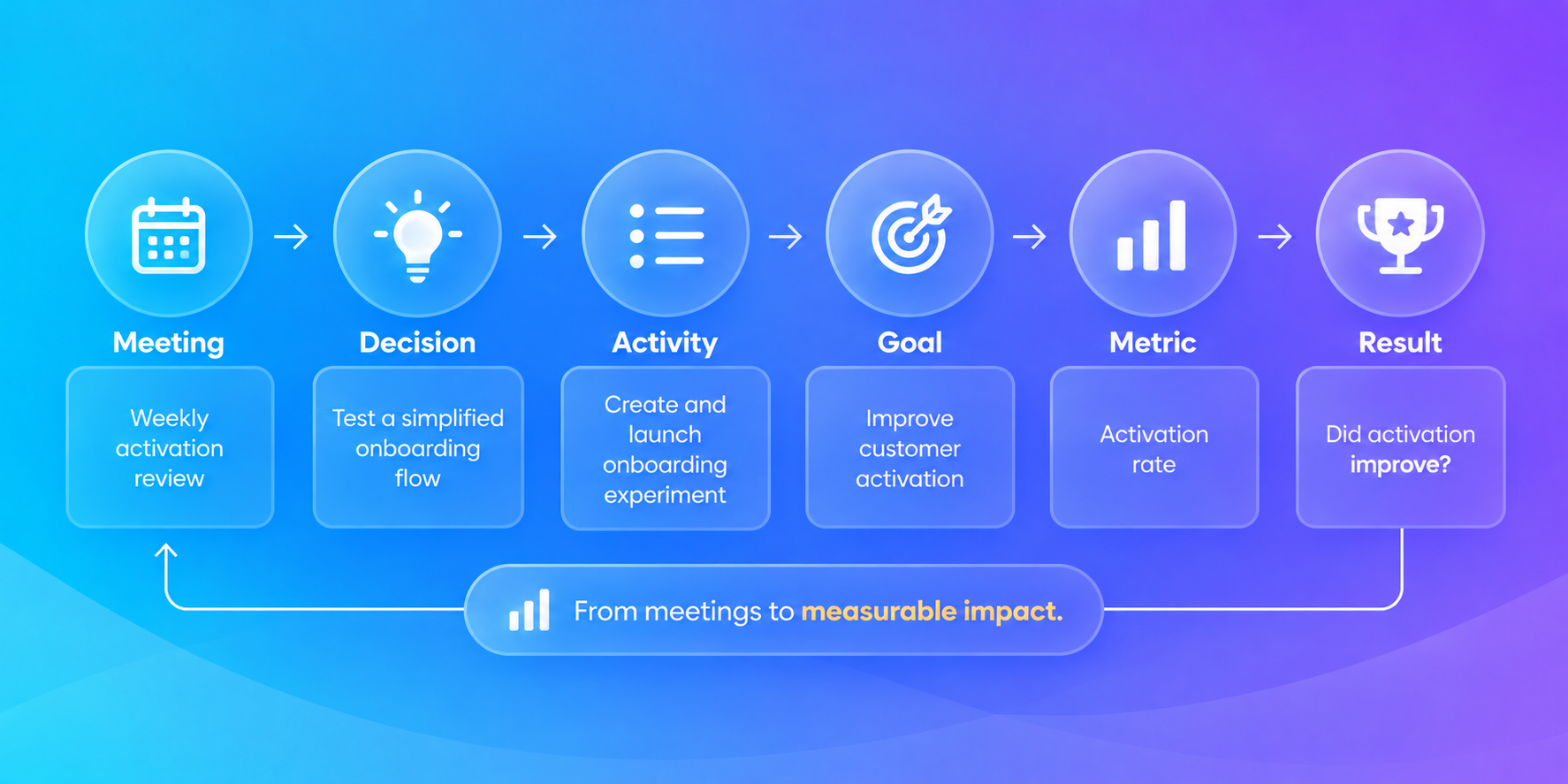
The meeting is now part of the execution system. It is not simply an event in the calendar. Beenia's product documentation describes meetings as connected to goals and activities, with agendas, participants, notes, decisions and action items.
7. Connect the Key Result to real data
This is where OKR execution becomes measurable.
Suppose your Key Result is:
Increase activation from 42% to 60%.
You need a reliable way to know where you currently stand.
The team might use:
- product analytics,
- CRM data,
- spreadsheets,
- operational systems,
- other external data sources.
The important principle is:
The Key Result should not live separately from the data that measures it.
Otherwise someone eventually has to ask:
What is the current number?
And someone else has to manually collect it.
Beenia supports goal progress based on activities as well as external data sources such as HubSpot and Google Sheets. This makes it possible to connect goal tracking with information that already exists outside the execution workspace.
The conceptual flow becomes:
External Data → Goal → Work → Progress
Activity progress vs outcome progress
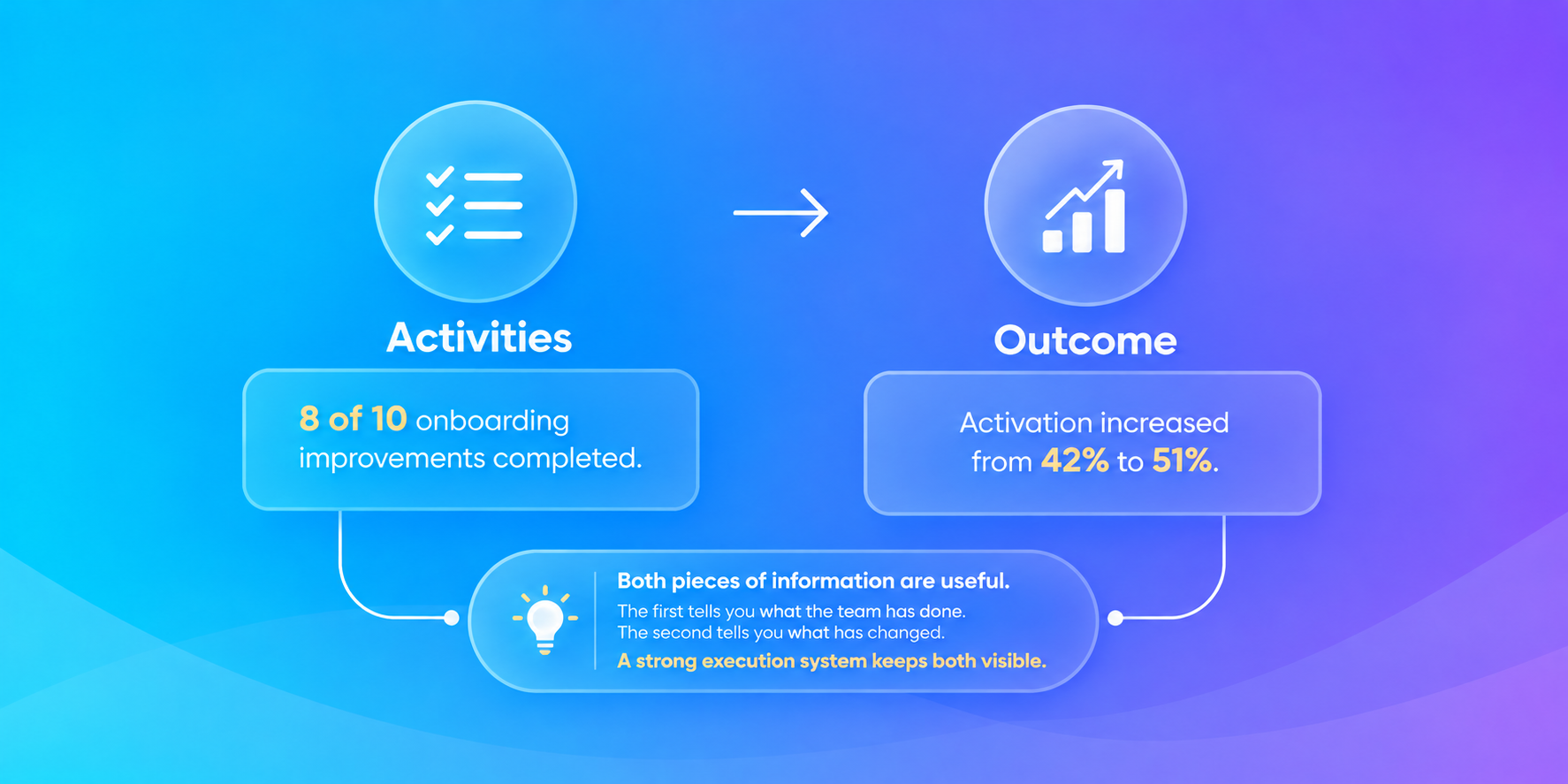
There is an important distinction here. Imagine your team has completed:
80% of the planned onboarding project.
That is useful information. But it does not necessarily mean:
80% of the way toward the business outcome.
These are different types of progress.
Activity progress
How much planned work has been completed?
Outcome progress
How much has the actual business metric changed?
For example:
8. Review progress regularly
An OKR should not disappear after the planning meeting.
Teams need regular opportunities to ask:
Are we moving toward the Key Result?
Is the work having the expected effect?
Are priorities still correct?
What is blocking progress?
What have we learned?
What should we change?
The frequency depends on the organization and the objective. Some goals may require frequent operational reviews. Others may move more slowly.
The principle remains the same:
Execution needs feedback.
Beenia provides goal progress tracking and goal history, with statuses such as On Track, At Risk and Completed, helping teams monitor the state of a goal over time.
9. Track dependencies and blockers
Sometimes a Key Result is not progressing because one piece of work is blocked by another.
For example:
Launch onboarding experiment
may depend on:
Complete product analytics setup
which may depend on:
Define event tracking
If these relationships are invisible, a delayed activity can look like a general execution problem. But if the dependencies are visible, the team can see:
Activity A → blocks Activity B → delays Project C → affects Goal D
Beenia supports goal and activity dependencies, including relationships such as Blocked by and Blocking.
This adds another useful dimension to OKR execution:
Goal → Work → Dependencies → Progress
10. Learn from the data
This is where the OKR process becomes more than tracking. Suppose the team works for six weeks on improving onboarding. The project is delivered. But activation only increases from 42% to 44%. The work was completed. The expected outcome did not materialize. What should happen next?
Not:
“The project is complete, so we're done.”
Instead:
“What did we learn?”
Maybe onboarding was not the main problem. Maybe users were reaching the product successfully but not finding enough value. Maybe another part of the customer journey has a stronger influence on activation.
This is why the execution loop should continue:
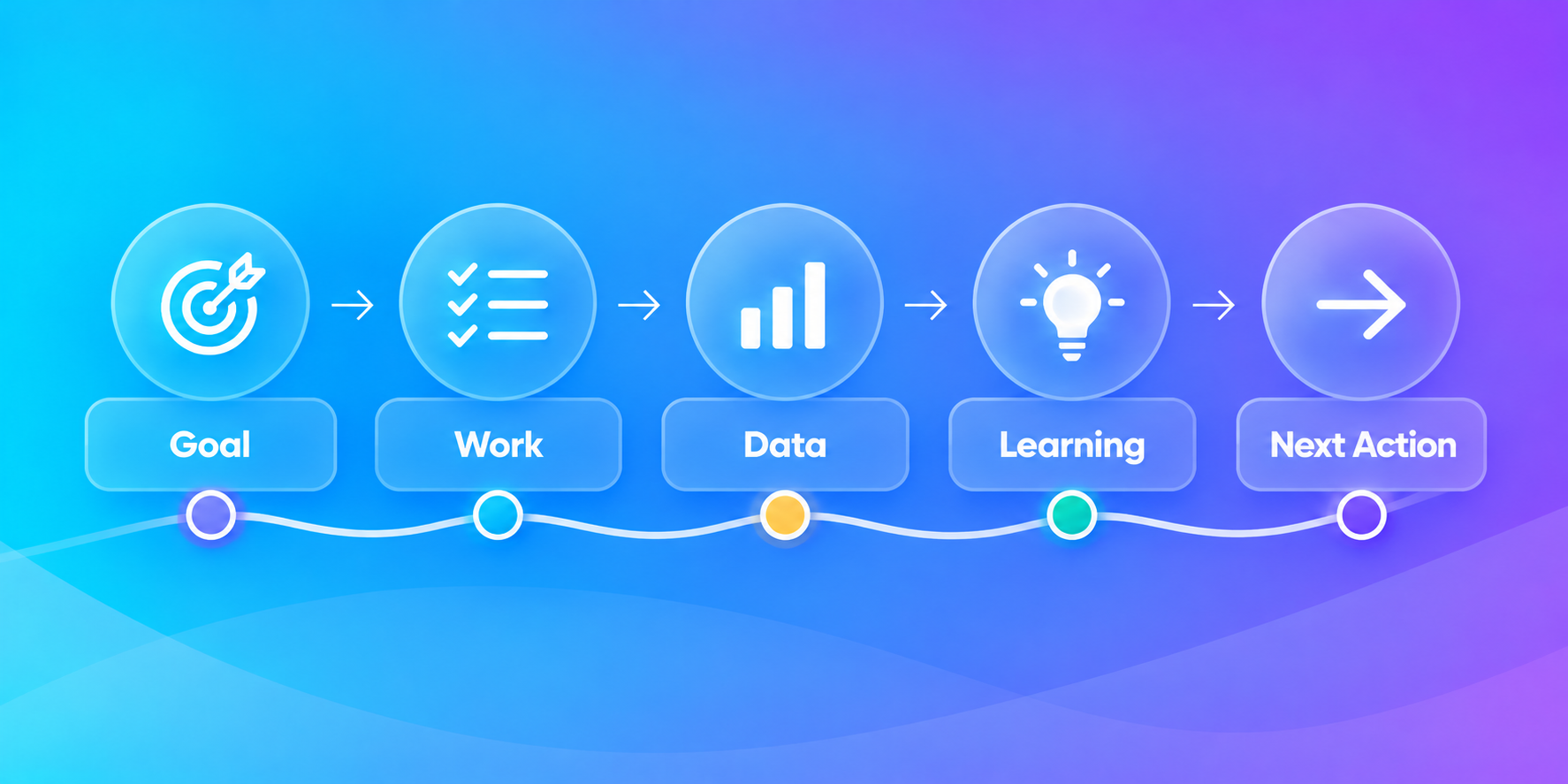
The objective is not simply to complete the original plan. The objective is to achieve the desired outcome — and adapt the work when reality provides new information.
OKR execution is a feedback loop
Putting everything together gives us a more complete model:
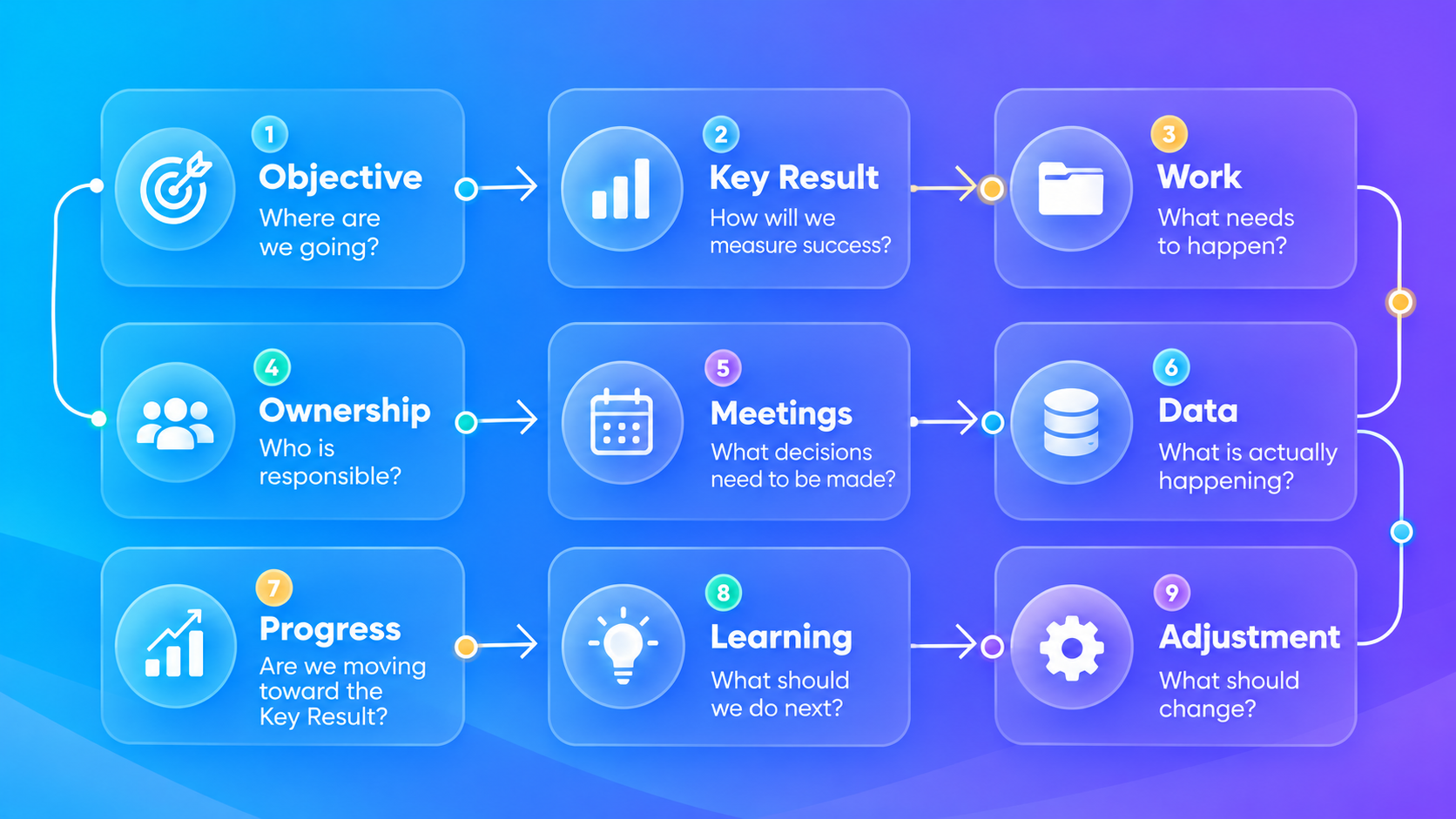
And then the cycle continues.
OKR → Work → Data → Learning → Action
This is the execution loop.
A practical example
Let's take a simple example. Imagine a SaaS company wants to improve customer retention.
Objective
Build stronger customer retention.
Key Result
Increase quarterly retention from 82% to 90%.
Now the company needs to translate that objective into execution.
Step 1 — Identify possible drivers
The team investigates why customers leave. They discover that onboarding and product adoption are two important areas to address.
Step 2 — Create subgoals
Improve onboarding
Increase product adoption
Step 3 — Create projects
Onboarding improvement project
Product adoption initiative
Step 4 — Define activities
For onboarding:
- Analyze onboarding drop-off
- Interview customers
- Redesign onboarding
- Test changes
For adoption:
- Identify unused core features
- Create education materials
- Launch customer campaigns
- Monitor feature adoption
Step 5 — Assign ownership
Product owns onboarding changes. Customer Success owns customer interviews. Marketing owns education materials. Growth owns campaigns.
Step 6 — Connect meetings
Weekly retention review:
Data → Discussion → Decision → Activity
Step 7 — Connect metrics
Relevant metrics might include:
- retention rate
- onboarding completion
- feature adoption
- customer engagement
Step 8 — Review
After several weeks: Retention: 82% → 84% → 87%
The team can now see both: what work has happened and whether the outcome is changing.
Step 9 — Learn
Suppose feature adoption increased significantly but retention barely changed. That tells the team something. The next question becomes:
What should we investigate now?
The OKR has become a learning system rather than simply a target.
What happens when OKRs are disconnected from execution?
Consider the opposite model. The company sets:
Objective: Improve customer retention.
The OKR is added to a presentation. The Key Result is added to a spreadsheet. Tasks live in a project management tool. Customer information lives in a CRM. Meeting notes live somewhere else. The team discusses progress in weekly meetings. Data is manually copied between systems. Everyone is working. But no one has a single connected view. The team has to repeatedly reconstruct:
Which work supports the OKR?
Who owns it?
What changed?
What does the data tell us?
What should happen next?
This is the gap between goal setting and execution.
Common OKR execution mistakes
Mistake 1: Treating the OKR as the plan
An OKR describes an objective and measurable results.
It does not automatically tell the team how to achieve them.
Execution requires work, ownership, coordination and feedback.
Mistake 2: Measuring only the Key Result
The Key Result tells you whether the outcome is changing.
But teams also need visibility into the work intended to influence it.
You need both: Outcome visibility and Execution visibility.
Mistake 3: Creating tasks without connecting them to goals
A large list of tasks does not necessarily represent progress toward a strategic objective.
Important work should have context. Ask:
Which goal does this support?
Mistake 4: Treating meetings as separate from execution
If decisions made during meetings do not become visible actions, the execution loop is broken. Try:
Meeting → Decision → Activity → Goal
Mistake 5: Updating progress manually without context
A percentage such as:
67% complete
does not explain what the percentage represents.
Is it:
- completed tasks?
- completed milestones?
- progress toward the Key Result?
- a business metric?
The definition of progress needs to be clear.
Mistake 6: Never changing the plan
An OKR is not a reason to blindly follow an original plan.
If new data shows that the current work is not producing the expected outcome, teams need to learn and adapt.
Execution should be goal-driven, not plan-locked.
How often should OKRs be reviewed?
There is no single review frequency that works for every organization or every goal.
The right cadence depends on:
- how quickly the relevant metric changes,
- how much operational activity is involved,
- how frequently decisions need to be made,
- how quickly new information becomes available.
But the important distinction is between reviewing the goal and working on the goal. An OKR should influence ongoing execution. That means teams should be able to see its relationship to the work happening between formal reviews.
What should an OKR execution dashboard show?
A useful execution view does not need to show everything.
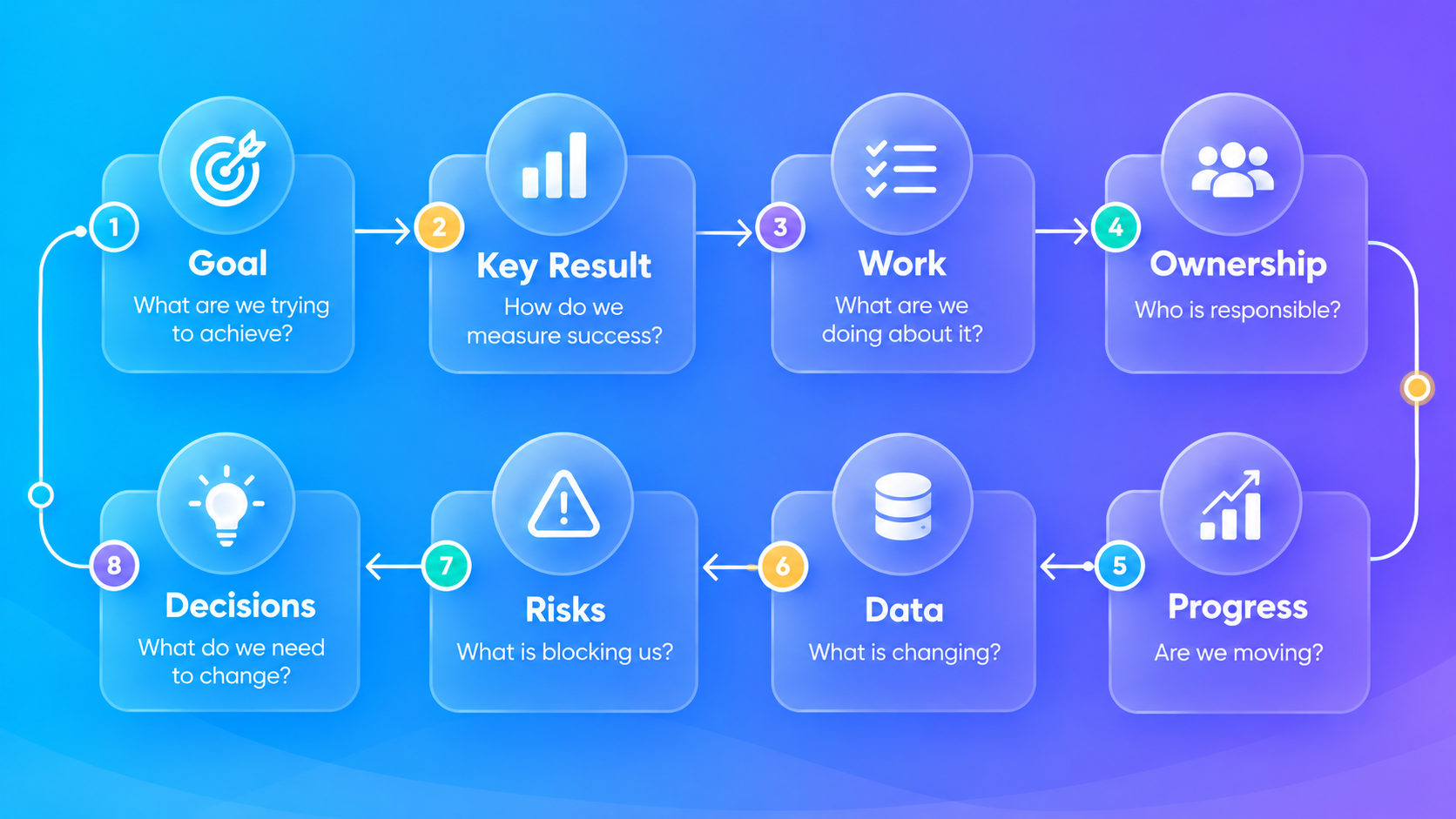
This is more useful than a dashboard that simply shows a collection of percentages. The goal of visibility is not more information. It is better understanding.
How Beenia can support the execution layer around OKRs
Beenia is not positioned simply as another place to write down objectives. Its role is to connect the elements that surround execution.
A goal can be structured with:
- parent goals and subgoals,
- deadlines,
- KPIs,
- connected activities,
- external data,
- dependencies,
- progress history.
Activities can be linked directly to goals, including through rule-based matching. Goal progress can be informed by completed activities or external data sources such as HubSpot and Google Sheets. Meetings can be connected with goals, activities, decisions and action items. This creates a connected execution flow:
Goal → Activities → Meetings → Data → Progress → Learning
And that is the important distinction.
The question is not only:
Did we set the OKR?
It is:
Can the team see what needs to happen because of it?
Can they connect the work to the goal?
Can they see whether the work is moving the result?
Can they learn and adjust?
That is where an execution platform can complement goal-setting frameworks.
OKRs and work management: how do they fit together?
OKRs and work management solve related but different problems.
OKRs answer:
What are we trying to achieve?
Work management answers:
What work is happening to achieve it?
Data answers:
What is actually changing?
Execution management connects them:
Are the things we are doing contributing to the things we want to achieve?
This creates a broader system:
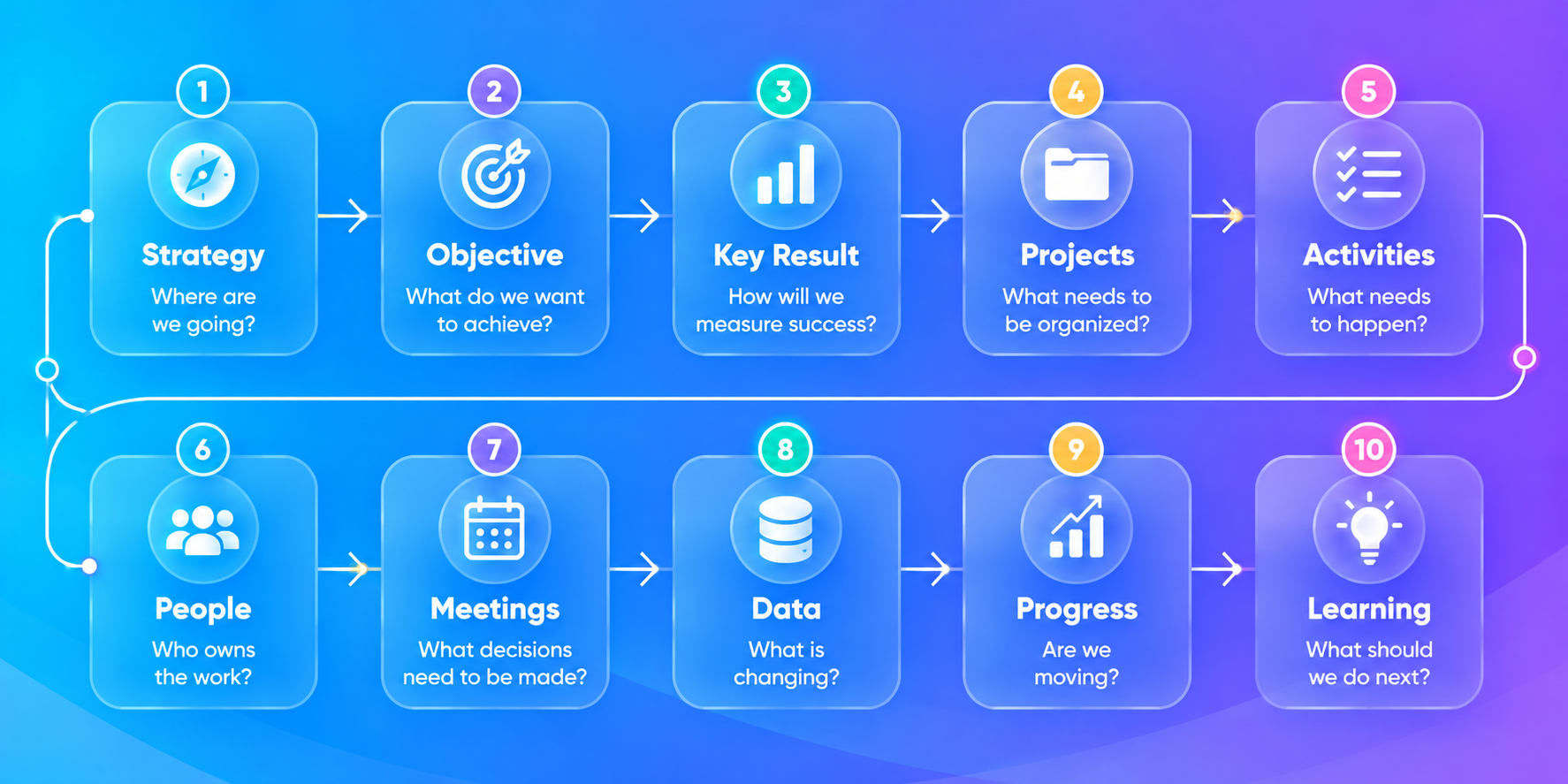
The important part is not the individual layer.
It is the connection between the layers.
The practical OKR execution checklist
Before declaring an OKR ready for execution, ask:
Goal
☐ Is the objective clear?
☐ Are the Key Results measurable?
Work
☐ Have we identified the work that can influence the Key Results?
☐ Are important projects connected to the relevant goals?
Ownership
☐ Does each important activity have a clear owner?
Meetings
☐ Are relevant decisions and action items connected to the work?
Data
☐ Do we know where the Key Result data comes from?
☐ Can we see changes over time?
Progress
☐ Can we distinguish activity progress from outcome progress?
☐ Can we identify blockers and dependencies?
Learning
☐ Do we regularly review what the data is telling us?
☐ Are we prepared to change the work when the evidence suggests a different approach?
If these connections are missing, the organization may have an OKR-setting process without a fully connected OKR execution process.
Frequently Asked Questions
What happens after you set an OKR?
After setting an OKR, teams need to translate the objective and Key Results into specific work, assign ownership, connect activities to the goal, monitor relevant data, review progress and adjust their actions based on what they learn.
How do you execute an OKR?
Start by defining the desired outcome, identify the projects and activities that can influence the Key Results, assign owners, connect work to the goal, track relevant metrics and regularly review progress.
How do you connect OKRs to daily work?
Break the OKR into manageable goals or initiatives and connect relevant projects and activities directly to them. This gives everyday work context and makes it easier to understand why an activity matters.
How often should OKRs be reviewed?
The appropriate cadence depends on the goal and the pace of the underlying work and metrics. The important principle is that teams should monitor progress often enough to identify problems and adapt execution.
What is the difference between OKRs and KPIs?
An OKR framework combines an objective with measurable Key Results to define what an organization or team is trying to achieve and how success will be measured. KPIs are metrics used to monitor performance. A KPI can be relevant to an OKR, but the two concepts are not identical.
Should every task be connected to an OKR?
Not necessarily. The most valuable connections are meaningful ones. Strategic and important activities should have a clear relationship to relevant goals, while minor operational tasks may not need a direct OKR connection.
Why do OKRs fail during execution?
An OKR can lose influence when it remains separate from everyday work. Common issues include unclear ownership, disconnected tasks, insufficient progress data, fragmented meetings and a lack of regular review and adaptation.
How can meetings support OKR execution?
Meetings can support execution when decisions and action items are connected to the goals and activities they affect. A useful model is Meeting → Decision → Activity → Goal → Result.
Final thought
An OKR is not the finish line. It is the beginning of an execution cycle. The objective gives direction. The Key Results define what success means. Work turns the objective into action. People create ownership. Meetings create decisions. Data provides feedback. Progress shows what is happening. Learning tells the team what to do next. So instead of thinking about OKRs as:
Objective + Key Results
think about the complete execution loop:
OKR → Work → Data → Learning → Action
Because the real question is not:
Did we set the right goal?
It is:
What happened because we set it?
And ultimately:
Did the work connected to that goal actually move the result?
That is where strategy becomes execution.
And where execution becomes measurable progress.
Beenia — connect goals with the work, data and decisions that move them forward.
.png)
.jpg)